
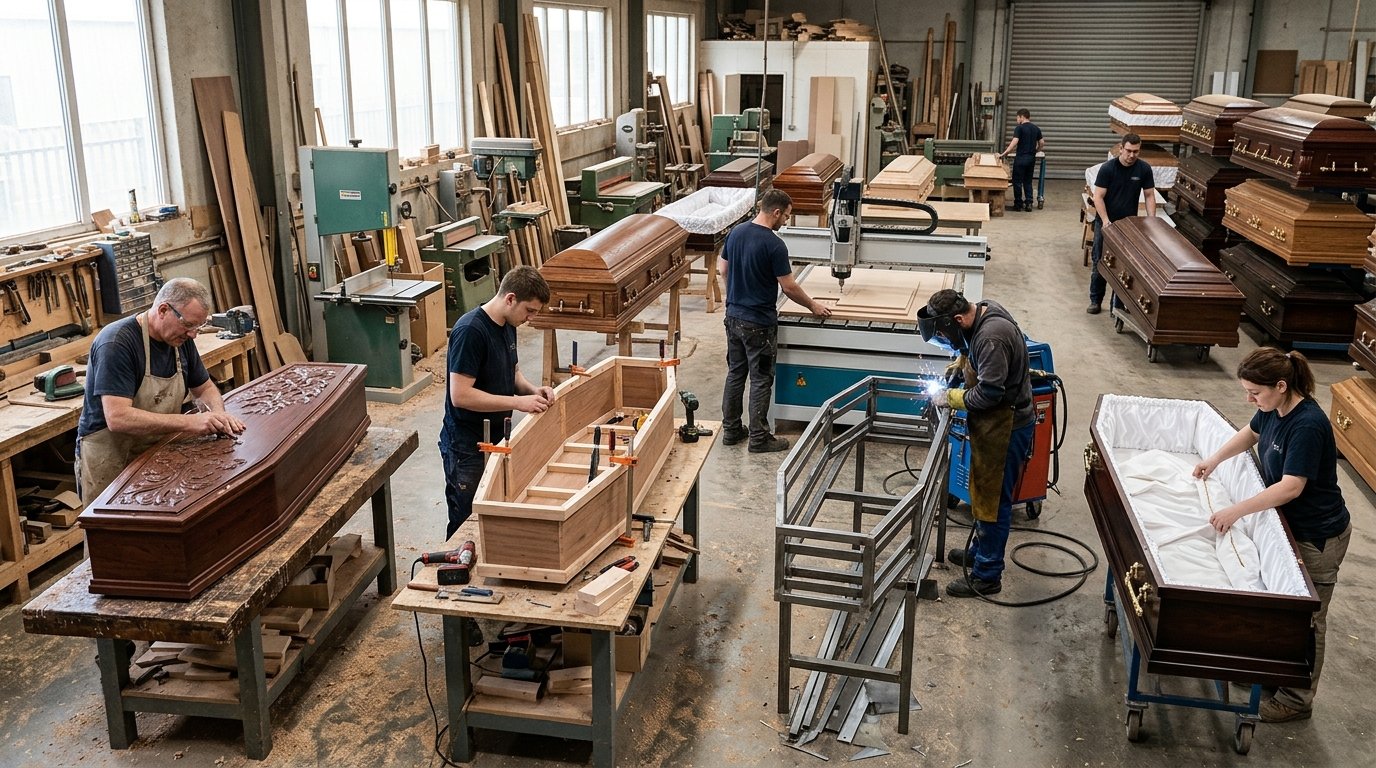
Traditional in-ground earth burial remains one of the most enduring, universally respected funeral customs worldwide. Behind the solemn beauty of a finished casket lies a sophisticated manufacturing discipline combining precision structural engineering, master artisan woodworking, and strict international compliance.
For funeral directors, mortuary distributors, and municipal service providers across Europe, the UK, and North America, selecting high-caliber traditional burial coffins requires an understanding of raw material selection, internal structural integrity, and sustainable production methodologies.
1. Raw Material Selection: The Foundation of Structural Permanence
An in-ground burial coffin must withstand significant earth loads, soil moisture, and physical displacement over time. Manufacturing begins with selecting and treating the finest structural timbers:
-
Natural Hardwoods (Oak, Hornbeam, Chestnut, Walnut): Kiln-dried to an optimal moisture content (8–10%) to prevent warping, cracking, or timber bowing under pressure. Hardwoods offer high fiber density, load-bearing rigidity, and natural, distinguished wood grains.
-
Structural Framing (Solid Pine Reinforcements): Fastened internally along stress-bearing corner joints and base perimeters to maximize dynamic weight capacity.
-
Engineered High-Density Fiberboards (MDF): FSC-certified 18mm high-density boards engineered for zero knot imperfections, smooth veneer adhesion, and consistent structural uniformity across high-volume production batches.
2. Multi-Stage Industrial Manufacturing Process
Modern casket manufacturing bridges high-capacity CNC machinery with handcrafted artisan assembly:
┌───────────────────────────┐      ┌───────────────────────────┐      ┌───────────────────────────┐
│ Precision Dimensioning    │ ───► │ Artisan Assembly &        │ ───► │ Multi-Coat Finishing      │
│ CNC cutting, routing, and │      │ Finger-joint joinery,     │      │ High-gloss polyurethane,  │
│ structural profiling      │      │ base bracing & hardware   │      │ satins, and sealants      │
└───────────────────────────┘      └───────────────────────────┘      └───────────────────────────┘
Precision Cut & Dovetail/Finger-Joint Joinery
State-of-the-art multi-axis CNC machines cut timber panels to exact metric or imperial tolerances. Master woodworkers then assemble corner joints using interlocking finger-joint or reinforced tongue-and-groove connections, reinforced with non-toxic, moisture-resistant bonding agents.
Reinforced Base Construction
The bottom panel undergoes specialized stress testing. Under European standard EN 15017, bases are engineered with multi-crossbeam supports and countersunk mechanical fasteners to ensure secure handling during pallbearing and mechanical vault lowering.
Surface Finishing & Lacquering
Outer surfaces receive multi-stage sanding before entering specialized spray booths:
-
Base Primer & Pore Filler: Seals natural timber grain to eliminate uneven absorption.
-
Topcoat Application: High-durability polyurethane gloss lacquers (such as PS.71.00), understated satin varnishes, or raw natural oil sealants applied in cleanroom environments to deliver a mirror-like or natural organic finish.